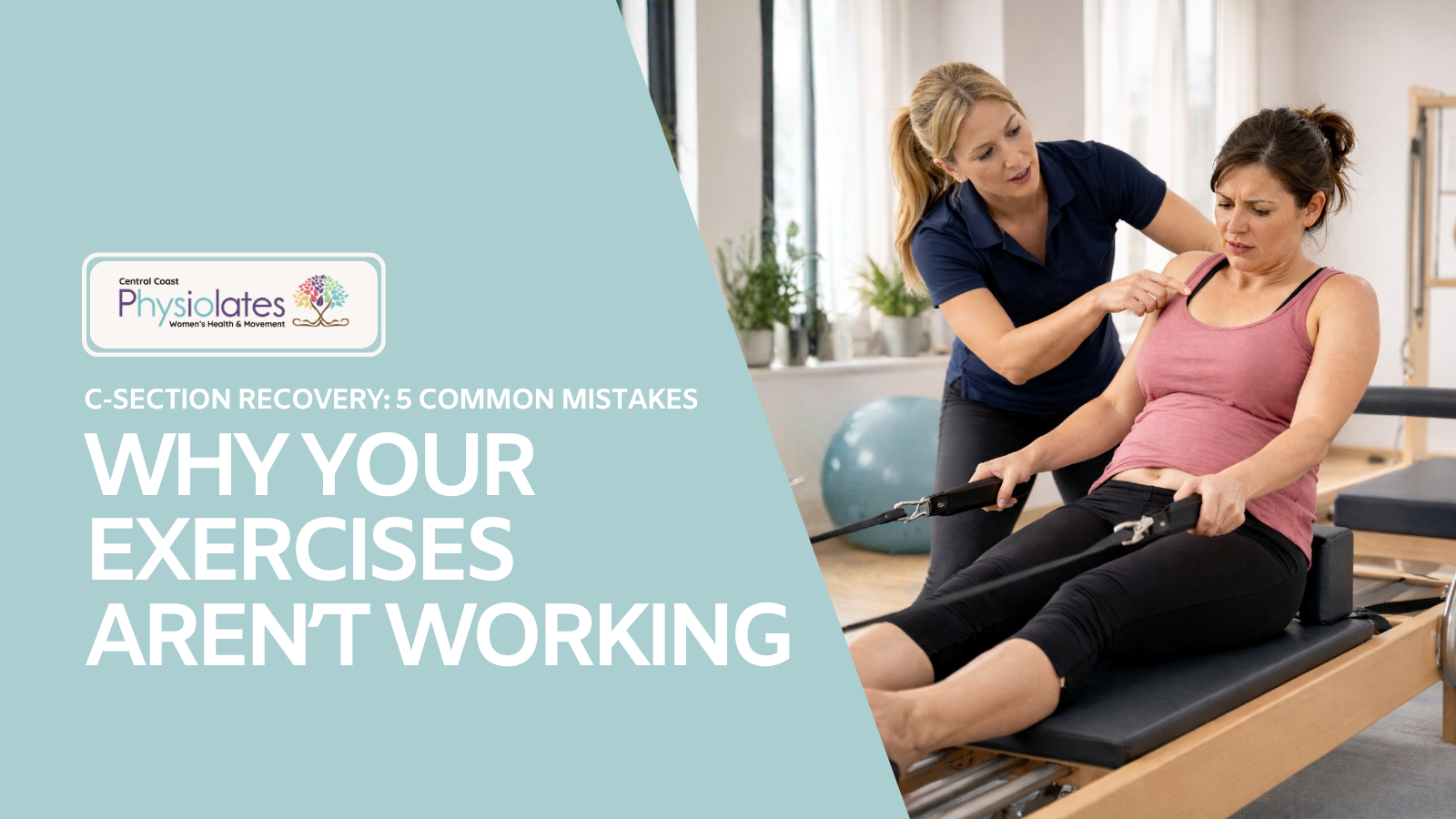
5 Common Mistakes Women Make With Movement After C-Section (And Why Your Exercises Aren't Working)
Feb 27, 2026You've been doing the exercises. You've joined a Pilates class. Maybe you're even working with a pelvic floor physio. But something's not clicking. Your core still feels disconnected. Movements that should be getting easier still feel impossible. And that nagging feeling that your body isn't responding the way it should? You're right.
Here's the thing: most women I see at Central Coast Physiolates have made the same five mistakes in their post-caesarean movement and recovery. It's not that they're doing something wrong, it's that no one told them what their body actually needs first. And no amount of core engagement or pelvic floor activation will work if the underlying systems haven't been restored.
If you're feeling frustrated and stuck, whether you've just had your C-section or you're months down the track and still not getting results, this is for you.
Understanding What Actually Happened During Your C-Section
Your caesarean section cut through seven distinct layers of tissue. Along the way, thousands of nerve endings were severed, lymphatic vessels were disrupted, and fascial planes were compromised. This isn't minor tissue trauma, it's major abdominal surgery that fundamentally alters how your body communicates with itself.
|
Yet most women jump straight into strengthening exercises without addressing the neurological, fascial, and lymphatic disruption that occurred during surgery. This creates a critical gap between what your body needs and what it's being asked to do.
That's the gap we address at Central Coast Physiolates, and it's why our approach to C-section recovery and women's health physiotherapy on the Central Coast gets results when other approaches haven't. |
 |
The Mistakes
|
1
Starting Strengthening Without C-Section Scar Tissue Mobilisation
When nerves are severed during surgery, your nervous system creates a protective pattern. It essentially 'forgets' that area exists, a phenomenon called sensory dissociation. Your brain can't effectively communicate with tissues it can't locate or feel. This is why you can't engage your core properly, even when you're trying your hardest. The neural pathways that should activate those muscles have been interrupted. "You can't strengthen what your brain can't find." Proper C-section scar tissue mobilisation is the essential first step. It restores mobility to the surgical site and reconnects sensory pathways so your nervous system can locate and communicate with your core again. This is one of the most important, and most overlooked, aspects of post-caesarean recovery that I see women missing, both in early recovery and months or even years after their surgery.
2
Ignoring Fascial Restrictions
Fascia is your body's continuous connective tissue network. After a C-section, adhesions and restrictions in this tissue create multiple problems:
Without healthy fascia, no amount of 'core engagement' will work. Until fascial mobility is restored, core strengthening exercises are building on unstable foundations. You're asking muscles to function in a system that can't support optimal function. If you've been working with a general physio or attending postnatal Pilates and not getting results, fascial restrictions are often the reason. Our comprehensive C-section assessment at Central Coast Physiolates identifies exactly what's been missed.
3
Skipping Lymphatic Flow Restoration
Your lymphatic system runs parallel to your nervous system, and both are severed during caesarean surgery. Tiny lymphatic vessels are cut, creating areas where fluid and metabolic waste products become trapped. This contributes to:
These vessels and nerves must find new pathways. Without addressing lymphatic flow through visceral mobilisation, lymphatic drainage, and movement science, you're trying to strengthen tissues that are essentially waterlogged and inflamed. Most exercise programmes, even postnatal ones, don't address lymphatic congestion. Yet restoring flow and clearing inflammation is essential for allowing your system to reconnect and respond properly.
4
Not Addressing Breath Dysfunction
Your diaphragm and core work together as an integrated pressure system. During pregnancy, your breathing patterns change, rib mobility decreases, and core timing gets disrupted. This adaptation doesn't automatically reverse after birth, especially after the additional trauma of abdominal surgery. If you can't breathe properly, your core cannot function properly. It's that fundamental. Yet breath restoration is rarely prioritised in postnatal programmes. I see it every week, women trying to engage a core system that lacks its primary driver. Without restoring diaphragmatic breathing and rib mobility, you're working with a compromised foundation. Breath restoration is foundational, not optional.
5
Thinking All Pilates Programmes Are the Same
Not all Pilates is created equal, and this distinction becomes critical after caesarean birth. Group fitness classes, even those labelled 'postnatal', cannot provide the individualised clinical assessment and treatment required for proper C-section recovery. Without a deep understanding of movement science, exercise can't 'fix' a system that isn't managing load correctly. True medical rehabilitation requires:
This isn't just Pilates with modifications. PhysioPilates is medical rehabilitation, and it's what separates our approach to post-caesarean recovery from a general fitness class. |
The PhysioPilates Difference: Foundation-First Rehabilitation
|
1
|
Scar Tissue Mobilisation
Restore mobility to the surgical site and reconnect sensory pathways so your nervous system can locate and communicate with your core again. |
|
2
|
Fascial Release
Release restrictions in the connective tissue network to restore proper nerve transmission, circulation, and movement capacity |
|
3
|
Lymphatic Flow Restoration
Use visceral mobilisation and lymphatic drainage techniques to clear inflammation and restore tissue quality |
|
4
|
Breath Function Rebuild
Restore diaphragmatic breathing and rib mobility to re-establish the core pressure system that underlies all core function. |
|
5
|
Strategic Strengthening
Only after these foundations are established do we layer in progressive strengthening that your body can actually respond to |
When to Seek Proper Assessment
|
|
||||
|
|
||||
|
|
||||
|
Ready for Your Body to Respond the Way It Should?
Book Your Comprehensive Assessment
Your Body Changes. Your Care Should Too.
From pregnancy and postnatal recovery to pelvic health, menopause and beyond, your body deserves care that makes sense for where you are now.
Join the Central Coast Physiolates newsletter for practical education, helpful resources and thoughtful guidance to help you better understand your body and feel more confident in your movement and health.
Your journey is important, and we'll never share your information.